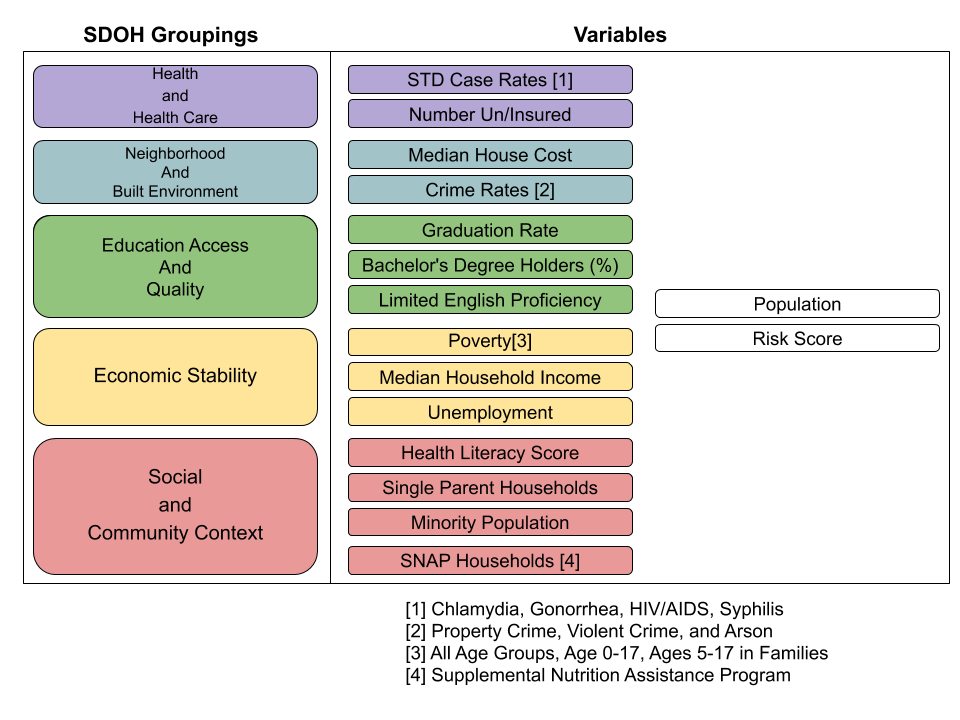
| Variable | Notes | Source | |||
|---|---|---|---|---|---|
| Population | Census, July 1, 2019. | Link | |||
| Unemployment | Unemployment rate, not seasonally adjusted for 2019 annual report. | Link | |||
| Uninsured | Percentage of population under age 65 without health insurance. | Link | |||
| Median Households Cost | Applying the House Price Index growth from FHFA to the latest housing data from the American Community Survey (ACS). | Link | |||
| Bachelors Degree Holder | VA Bachelors Degree or Better Education. | Link | |||
| Poverty | All people in poverty (2018), and children ages 0-17. | Link | |||
| Health Literacy | The health literacy estimates on this site range from 177 to 280, with higher numbers indicating higher health literacy. | Link | |||
| Poverty (Ages 5-17 in Familiies), Household Income | U.S. Census Bureau’s Small Area Income and Poverty Estimates. | Link | |||
| SNAP Households | U.S. Food and Nutrition Service, Supplemental Nutrition Assistance Program. | Link | |||
| STD Rates | Sexually Transmitted Disease (STD) infections, numbers of cases and rate per 100,000 (Chlamydia, Gonorrhea, HIV/AIDS, Early Syphillis). | Link | |||
| 4-Year Cohort Graduation Rate and Total | The Virginia On-Time Graduation Rate defines graduates as students who earn Advanced Studies, Standard, IB, or Applied Studies Diplomas for students who entered the ninth-grade for the first time together and were scheduled to graduate four years later (2019). | Link | |||
| Violent, Property, and Arson Crime | FBI’s Uniform Crime Reporting (UCR) Program, data presented in Crime in the United States reflect the Hierarchy Rule, which requires that only the most serious offense in a multiple-offense criminal incident be counted (2019). | Link | |||
| Percent Single Parent Households, Minority, and Limited English Speaking Ability | Single parent household with children under 18, Minority (all persons except white, non-Hispanic) estimate, persons (age 5+) who speak English "less than well" (2014-2018 ACS). | Link | |||